Library - In Memoriam
Remembering oral history interviewees who have passed away.
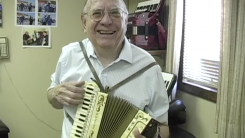
Harry Osiecki’s father started a music store out of his parent’s home. In 1933, he opened up his first store, which had a living unit upstairs for his family.
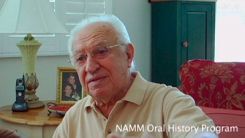
Ed Rizzuto was surrounded by music his entire life. As a young boy he started playing trombone, which he continued throughout high school and into his military service in the early 1950s.
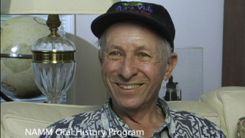
Marvin Snyder became president of Rico Reeds in 1976, after managing the cane plantations, which were used to make the reeds.
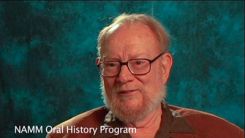
John Eaton spent the latter part of the 1960s composing for electronic musical instruments such as early synthesizers developed by Robert Moog and Paul Ketoff. His microtonal music included several works for live performances such as “Song for R. P.
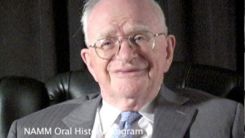
Norman Pickering had a storied career. He worked as instrument designer for the legendary C.G. Conn Company in Elkhart. He also played a large role in the audio engineering field with his company, Pickering Audio, which produced record pick-ups for radio stations around the world and designed the modern phonograph cartridge. As an engineer, he also worked on airplanes and even medical ultrasound techniques, yet he was never too far from the field of musical engineering, which he loved. Norm passed away in the fall of 2015 at the age of 99.
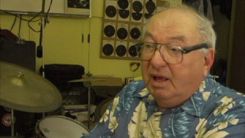
Phillip Stanger began playing drums at an early age and took lessons from the famed percussionist, Roy Knapp. Phil remembers with great joy the first time he walked into Frank’s Drum Shop in Chicago.
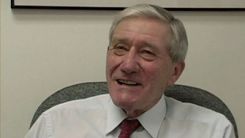
Crane Bodine’s father, Elmer, was a piano man who formed a retail store in Minneapolis, Minnesota in 1933. When Crane was 17 years old, he began working in the store. In 1962, he took over as president shortly after his father’s passing.
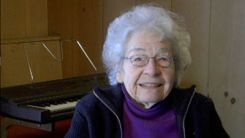
Delores Rhoads began teaching music in 1939. Seventy years later when she was interviewed by NAMM, she was still teaching. After World War II Delores and her husband opened a small teaching studio and retail shop in North Hollywood, California, called Musonia.
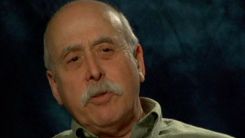
Michael Kropp loved folk music for as far back as he could remember. As he grew up and played in various bands in the 1960s and 70s he also became involved with the music industry.
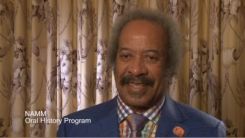
Allen Toussaint represented one of the quintessential New Orleans sounds. Toussaint’s compositions and songs seamlessly blend blues, jazz, ragtime, R&B, and funk to create an amalgam that is unique and readily identifiable to New Orleans.